
Gen Z has grown up with the internet, but a new survey suggests their biggest digital dependence may no longer be social media. Instead, it is conversational AI.
In December 2025, AIResumeBuilder.com surveyed 1,200 Gen Zers ages 18 to 28 to find out how often they use ChatGPT and similar tools, how important these tools have become in their daily routines, and whether they could realistically go without them.
Top findings:
- 4 in 10 Gen Zers use ChatGPT or similar tools daily
- 9 in 10 Gen Zers say they’re reliant on conversational AI
- 1 in 4 Gen Zers would rather give up social media than ChatGPT
4 in 10 Gen Zers Use ChatGPT Daily
Conversational AI is not an occasional experiment for Gen Z. It is a regular habit. Seven in 10 Gen Zers report using ChatGPT or a similar AI tool within the past month, and many say they use these tools daily, or even multiple times a day.
Among Gen Zers who have used conversational AI in the past month, 39% say they’ve used it multiple times per day, while another 24% use it once per day. Approximately 27% report using it a few times per week, while only 10% use it once a week or less.
When it comes to which platforms they are using, ChatGPT is far and away the most common. Among Gen Zers who have used conversational AI tools, 93% have used ChatGPT, followed by Gemini (57%), Copilot (28%), Perplexity (12%), and Claude (10%).
Men and higher earners are more frequent users
Usage patterns differ slightly across demographics. Men were more likely than women to say they used ChatGPT or a similar tool in the past month (75% vs. 66%).
Income also appears tied to adoption. Gen Zers with household incomes under $50,000 were the least likely to report using conversational AI tools in the past month (63%). Usage increases among those earning $50,000–$99,000 (77%), and is highest among Gen Zers with household incomes of $100,000 or more (80%).
Gen Z Uses Conversational AI Most Often for Brainstorming, Research, and Problem Solving
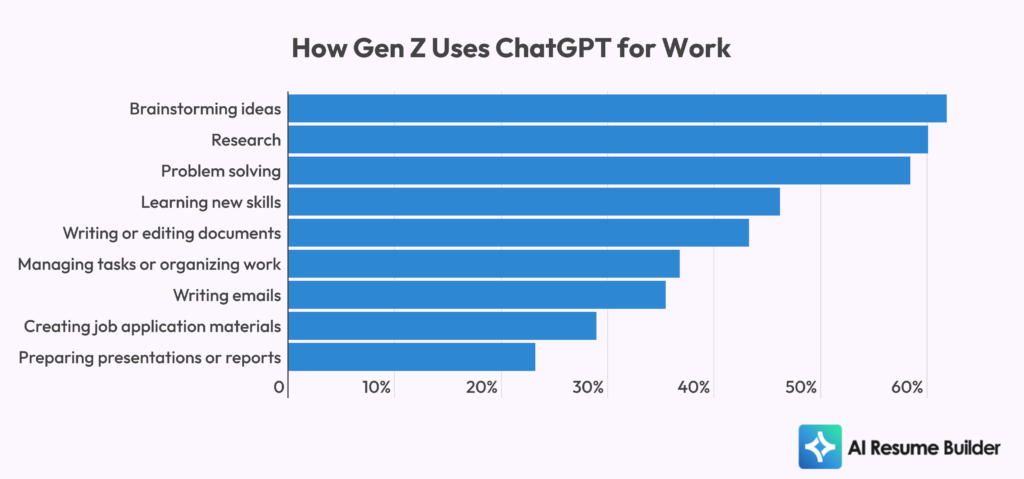
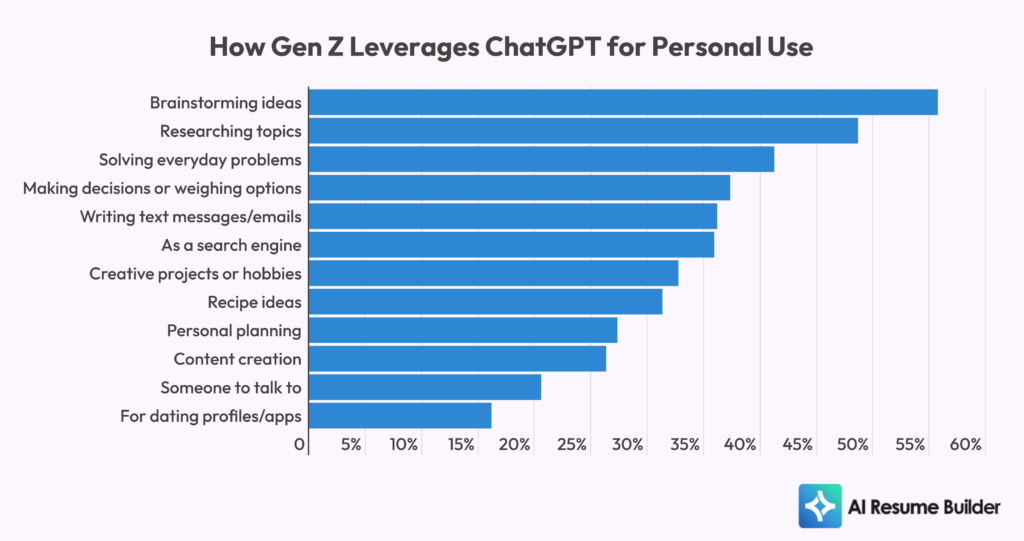
Conversational AI is deeply embedded in how Gen Z approaches both work and everyday life. Among Gen Zers who have used ChatGPT or a similar tool in the past month, 96% report using it for work-related purposes, and 98% report using it in their personal life.
For work, the most common ways respondents regularly use ChatGPT or similar AI tools are brainstorming ideas (62%), research (60%), and problem-solving (58%). Nearly half also use it for learning new skills (46%) and writing or editing documents (43%), while 37% report using it for managing tasks or organizing their work.
In their personal lives, Gen Zers are most likely to use conversational AI for brainstorming ideas (56%), researching topics (49%), and solving everyday problems (41%). Many also use it for making decisions or weighing options (37%), writing messages such as texts or emails (36%), and using it as an alternative to Google as a search engine (36%).
“Brainstorming, research, and problem-solving are the most time-consuming parts of many jobs and also the easiest places to get stuck. Gen Z is using ChatGPT to remove friction and move faster,” says AI Resume Builder’s career advisor Rachel Serwetz.
“What this suggests is that they are not using AI just to automate busywork. They are using it to sharpen their thinking, speed up decision-making, and improve the quality of their work.”
9 in 10 Admit They’re Reliant on Conversational AI
Among Gen Zers who used conversational AI in the past month, nearly all say they rely on these tools to some degree. Overall, 91% say they are at least somewhat reliant on ChatGPT or similar AI tools. Specifically, 24% say they are totally reliant, 35% say they are very reliant, and 31% say they are somewhat reliant. Just 10% say they are not reliant at all.
“When a tool is this useful, people will naturally reach for it first. The risk is that some workers start outsourcing their thinking instead of using AI to strengthen it,” explains Serwetz.
“The healthiest use of ChatGPT is as a partner. It can generate options, improve drafts, and pressure test ideas. But the judgment and final decision still has to come from the human, or their team collectively. Otherwise, you end up with speed but not real growth.”
Looking ahead to 2026, respondents generally expect conversational AI to remain important and potentially become even more integrated into their lives. For work, 44% expect ChatGPT or similar tools to become more important, while 47% say they will stay about the same in importance. For personal life, 38% expect these tools to become more important, and 52% anticipate they will remain about the same.
“I would argue that AI will be even more important in 2026 than most people expect. AI tools are being built directly into everyday workflows, and employers are increasingly expecting workers to know how to use them,” notes Serwetz.
“The shift is not just better tools. It is changing norms. In the same way you are expected to know Slack or Google Docs, AI fluency is becoming a baseline skill. By 2026, not using AI in many roles will feel like choosing to work without the internet.”
1 in 4 Gen Zers Are More Willing To Give Up Social Media Than ChatGPT
Perhaps the most striking finding is that a meaningful share of Gen Zers say they would rather lose access to social media than lose access to ChatGPT.
Overall, 24% say they would rather give up access to social media than access to ChatGPT or similar conversational AI tools. Individuals with higher incomes are more likely to opt for conversational AI over social media. Twenty-nine percent of Gen Zers with household incomes of $100,000 or more say they would rather give up social media, compared to 23% of those with incomes under $100,000.
Men are also slightly more likely than women to take this stance, with 27% of men saying they would rather give up social media compared with 24% of women.
“AI is becoming a part of our essential digital infrastructure. When people would rather lose Instagram than lose an AI assistant, that signals a significant shift in what Gen Z values and depends on day-to-day. AI is no longer a novelty for a meaningful share of this generation. It is a utility. Social media allows for entertainment and connection, but ChatGPT is increasingly seen as something that helps them function,” says Serwetz.
Methodology
In December 2025, AIResumeBuilder.com conducted a survey of 1,200 Gen Z adults aged 18–28 using Pollfish. Respondents were asked about their use of ChatGPT and similar conversational AI tools, including frequency of use, perceived reliance, and how they use these tools in both work and personal settings. Attention checks and other quality control measures were used to ensure data reliability. The survey has a 95% confidence level and a margin of error of ±3 percentage points. Media inquiries can be directed to [email protected].